
Private Label Home Fragrance: What Travels With a Sample to Bulk
A home fragrance range is approved on a sample and paid for in bulk, and the difference between the two is rarely a chemistry problem. It is a handover problem: the sample that convinced you was never documented well enough for the production line to match. Candles, reed diffusers and room sprays carry scent through different bases, so the reference travelling from the sampling room to the filling line has to describe more than how the juice smelled. Build a documented handover pack, agree who holds it, and the second batch behaves like the first.
Key takeaways
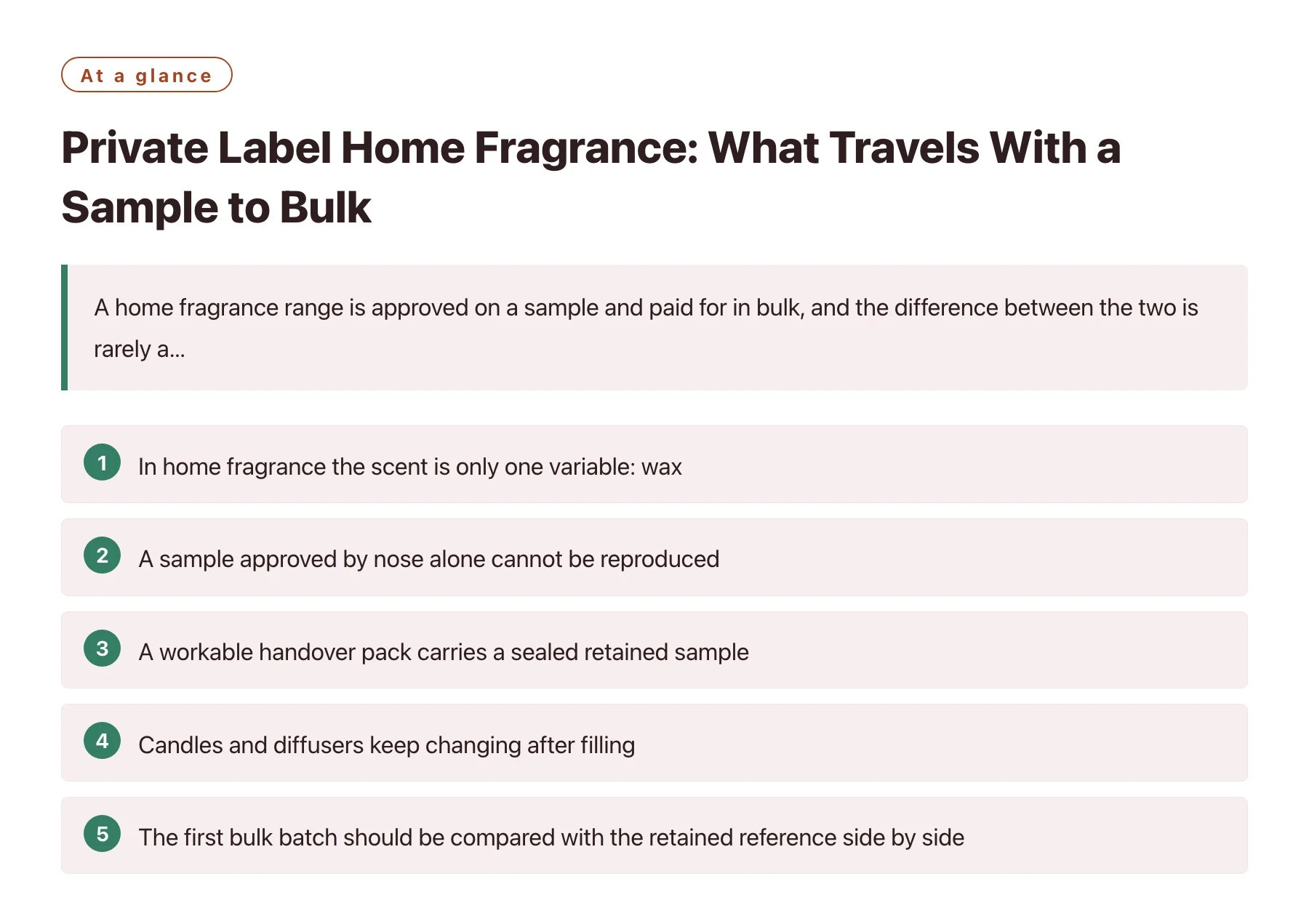
- In home fragrance the scent is only one variable: wax, wick, fill weight, cure time, reed count and alcohol ratio all move the smell as much as the formula does.
- A sample approved by nose alone cannot be reproduced, because the people filling the bulk order have no written reference to match against.
- A workable handover pack carries a sealed retained sample, the approved compounding sheet, fill and process parameters, the packaging specification and a stated assessment method.
- Candles and diffusers keep changing after filling, so the reference sample must be taken and judged at an agreed point in that settling period rather than on the day of production.
- The first bulk batch should be compared with the retained reference side by side, on the same day, by the same two or three noses.
Private label work in this category usually starts well. You brief a manufacturer, receive two or three fragrance directions, choose one, and hold a sample that smells right on the day. The difficulty starts afterwards, when that sample becomes a purchase order and the people who will make it have never met you.
Home fragrance makes this harder than fine fragrance does. A perfume is judged from a bottle; a home fragrance is judged from a room, and the room is shaped by wax type, wick size, fill weight, cure time, reed count, alcohol ratio and the vessel itself. Two batches can carry an identical fragrance compound and still read differently in the same living room.
This article is about the handover rather than the scent: what should physically travel from sampling to the bulk order, and what to do when the first pallet does not match what you approved.
Why the gap opens at handover
Most arguments about a bulk home fragrance order are arguments about an object nobody kept. The brand remembers a candle; the factory remembers a formulation sheet. When the two memories drift apart, there is no shared artefact to appeal to, and the discussion turns into a matter of opinion rather than a comparison.
Written specifications close part of that gap, but only the part that can be typed. Fill weight, wick specification and wax blend are straightforward to state. What is harder to write down is the sensory target: how strong the scent should read at the moment of lighting, how far it should carry in a small room, and how it should behave after an hour. That is what a retained sample is for.
Each format drifts for its own reason
A candle changes as it cures, because the fragrance distributes through the wax over days; a candle poured on Monday does not smell like the same candle on Friday. A reed diffuser depends on the viscosity of the base liquid and the number of reeds, so a small change in either moves the release rate in a direction nobody intended. A room spray is the closest of the three to a conventional fragrance project, and even there the alcohol-to-water ratio changes how quickly the top notes lift off the surface.
Because the mechanisms differ, one generic reference cannot cover a whole range. If you launch a candle and a diffuser with the same scent name, each format needs its own approved object and its own parameters. A manufacturer that runs several home categories in one programme can keep those references aligned with each other, which is one practical argument for a factory that handles fragrance R&D and production rather than three specialists who never speak.
The reference has to be taken at a known point
The common mistake is retaining a sample the day it was produced and then comparing a later bulk batch against it, months after it was opened and left on a shelf. If the reference was never allowed to settle, it is not a fair benchmark. Agree the assessment point in writing, count the days from filling, state the storage temperature, and retain the reference from that moment rather than from the end of the line.
A late change of strength can force a reformulation
Fragrance compounds are used under restrictions that depend on the product category and on how much of each material ends up in the finished article. If a scent is judged too soft after the first samples and the dosage is raised, the change may push a restricted material past its allowance, and the formula has to be rebuilt rather than simply strengthened [1]. This is one reason to settle the intensity target before the compounding sheet is approved, not after the first bulk quote.
What belongs in the handover pack
| Item | What it pins down | How it usually gets lost |
|---|---|---|
| Sealed retained sample | The sensory target, judged after the agreed settling period | Kept informally, or kept by someone who has since left the project |
| Approved compounding sheet | The exact fragrance compound and dosage, with a version number | Superseded by a later email that never reached the compounding lab |
| Fill and process parameters | Fill weight, wick specification, pour temperature, cure window | Agreed verbally during a factory visit and never written into the order |
| Packaging specification | Vessel, closure, label artwork, carton and any insert | Split across three suppliers, so no single party holds the whole picture |
| Assessment method | Who smells what, when, and against which reference | Left to whoever happens to be free on the day the pallet arrives |
None of these five items is expensive to produce. The cost of omitting one shows up later as a rework order, a discount negotiation or an unsold container, and it is always larger than the paperwork would have been.
Building the pack before the bulk order
- Write the sensory target in sentencesDescribe when the scent should be noticed, how far it should carry and how long it should stay recognisable in a room. Sentences age better than adjectives.
- Fix the assessment pointState how many days after filling the reference is taken, and at what storage temperature. Then take it exactly there.
- Version the compounding sheetGive every approved formula a number and a date, and refuse to treat any later verbal adjustment as approved until it carries a new one.
- Record the process parametersFill weight, wick, pour temperature and cure window belong in the same document as the scent, because they change the scent a buyer actually experiences.
- Name one holder on each sideOne person at the brand and one at the manufacturer own the current version. Two copies that drift are worse than one copy that is wrong, because the disagreement stays hidden until volume.
Checking the first bulk batch against the reference
When the first bulk order ships, the test is a comparison rather than an impression. Put the retained reference and the new batch in identical vessels, in the same room, at the same time of day, and assess them in the same order for both samples. Two or three noses are enough; more people produce more opinions without producing more evidence.
If your supplier runs private label perfume manufacturing for several brands, the batch record and the retained reference should exist as a routine part of the release process rather than as a favour. Ask to see the record for your own run. A document that was created for the factory's internal release is more convincing than one written afterwards to answer your questions.
When the batch does not match
A mismatch is not automatically a defect, and the first task is to classify it. Three categories cover most cases: the formula is different, the format parameters are different, or the assessment is different. Only the first two are production issues. The third is a meeting.
Where a real difference exists, batch records, retained samples and third-party laboratory testing are the tools that settle it, because they document what was actually filled rather than what was intended [2]. The sequence of perfume manufacturing process matters here too: if the difference appeared at the filling stage rather than at compounding, the fix belongs on the line, not in the formula.
Whichever way it resolves, write the outcome into the next version of the handover pack. Each bulk order should leave the documentation slightly better than the one before it, which is how a private label range becomes repeatable instead of lucky.
The cheapest moment to prevent a bulk disappointment is the week after sample approval, when everyone still remembers what the sample was meant to be. Spend an hour then writing the five items down, and you avoid the conversation that starts with the words 'this is not what we approved'.
Sources
- IFRA Standards Library (International Fragrance Association) —— The IFRA Standards Library lists the restrictions the fragrance industry applies to individual fragrance ingredients, based on safety assessments; it is the reference point for compliant fragrance formulation.
- SGS: Cosmetics, Personal Care & Household Testing —— Testing, inspection and certification services for cosmetics and personal care, including microbiological, stability and safety testing aligned with cosmetics GMP.
Frequently asked questions
How long should I keep the approved home fragrance sample?
Keep one sealed reference for as long as the product is on sale, and keep a second opened sample for comparison purposes if you can. Fragrance compounds and waxes change over time, so the reference is only useful if it has been stored in the same conditions you promised.
Why does my candle smell weaker than the sample I approved?
The usual causes are a shorter cure before shipping, a different wax or wick specification, or a fill weight that moved. Ask for the batch record and compare the parameters of the two runs before assuming the fragrance compound changed.
Should a reed diffuser use the same fragrance dosage as a candle?
Not automatically. The base liquid and the number of reeds control how much scent is released, so the same compound can read stronger or weaker depending on the format. Treat each format as its own brief with its own reference.
What is a reasonable way to compare two batches by nose?
Same vessel, same room, same time of day, same assessors and the same order of evaluation. Blinding the samples helps more than adding people, because a label tells the assessor what they are expected to smell.
Who should hold the handover pack?
One named person on the brand side and one on the manufacturer side, with a rule that only the current version counts. Shared folders help, but the version discipline matters more than the software.
When the next 72 hours decide everything.
A senior partner is on a confidential call within nine minutes of hotline activation, 24/7/365. Briefings are conducted under standing NDA and leave no record of inquiry.
Book a Confidential Briefing